


Table of Contents | Introduction | Historical Notes
As we entered the grand ballroom, the dance floor was already crowded with dancers, their costumes and masks a wash of color as they flowed counter-clockwise to a Strauss waltz. The parquet floor was laid in the Versailles pattern, cut from walnut and maple. Gold silk draped the ceiling between small crystal chandeliers. Between the mirrored panels on the walls, gas sconces threw a warm light across the room. At the center, one grand chandelier presided over the rest.
“Herr Knopf! Emilie!”
A figure approached from the left, tall and unmistakable despite the elaborate peacock costume. Blue and green feathers covered his coat, with more feathers sprouting from his shoulders. His mask was an absurd beaked thing that should have looked ridiculous, but somehow worked.
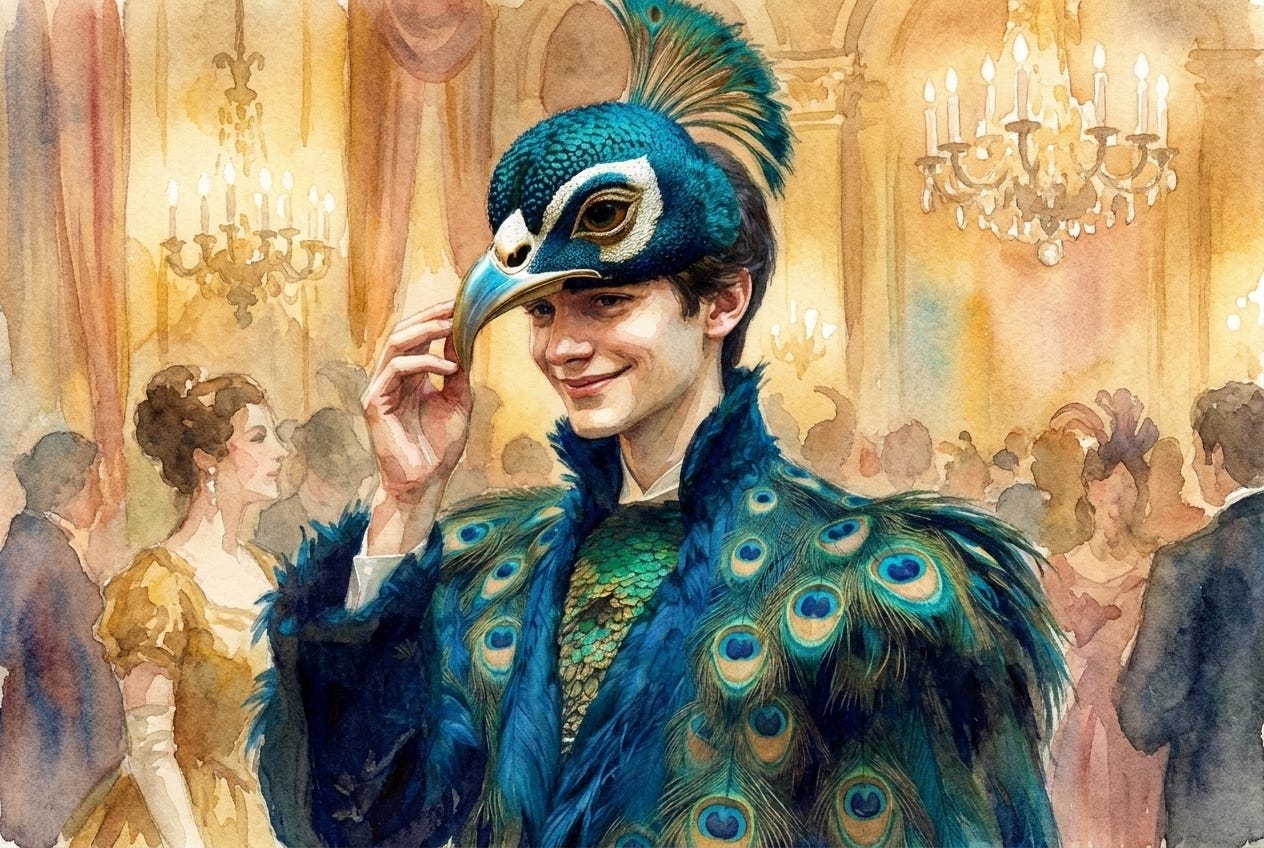
Of course, I was not supposed to know who it was, but Otto was impossible to mistake. Standing at just over six feet, his lanky frame moved with the kind of awkwardness that suggested he had grown into his height only recently and had not yet figured out how to maneuver.
Papa smiled. “Ah. A magnificent bird swoops in.”
“Herr Knopf, might I borrow your daughter for a moment? I promise to return her undamaged.”
“Of course.” Papa glanced at me. “Remember what you are here for, Liebling. Be about your business tonight.”
Otto offered his arm and led me toward the refreshment room before Papa could add anything else.
“Was war das?” Otto asked once we were out of earshot.
“The usual. Finding a husband.”
“Ach.” He laughed, sharp and knowing. “I’m feeling the same pressure from my parents. My father cornered me last week.” He held an imaginary monocle up to his bird mask, voice dropping into a passable imitation of General von Reinhausen’s parade-ground tone. “It simply will not do for a young man to remain single after he graduates from university. You must be on the lookout for a suitable companion if you want a position in the Staatsdienst.”
I smiled despite myself. “At least you can marry and then ignore her if you don’t get on. Live your own life.”
“True.”
“I can’t do that. I’ll have—” I paused, not wanting to speak the word I feared so much. “Responsibilities.”
Otto considered this, and when he spoke again, his voice had lost its playful edge. “Husbands have their duties as well.”
Before I could imagine what duties he feared, he took me by the hand and dragged me through the crowd. We passed someone who looked familiar, dressed as Julius Caesar, deep in conversation with a Cleopatra, and a woman in an elaborate swan costume laughing at something her companion said.
“I’m hungry,” Otto announced.
“I’m sure we can find you some worms around here somewhere. Perhaps we should look in the garden?”
He snorted. “Dreadful. You’re dreadful.”
The refreshment room was smaller than the ballroom and less crowded. Tables lined the walls beneath white linen, laden with the particular excess of a family that understood hospitality as a form of excess — platters of Aufschnitt, the cold meats fanned out with architectural precision, wheels of cheese, Laugengebäck stacked in baskets, the dark bread of Berlin alongside lighter rolls, bowls of fruit, and at the center of it all a great crystal basin of Erdbeerbowle set on a silver stand, the strawberries floating in its golden depths. Waiters moved through the room with trays, offering champagne to anyone whose hands were empty.
“The Bleichröders have outdone themselves.” Otto appeared at my elbow, already holding a plate he had assembled with impressive speed. “Champagne?”
“Nein,” I said.
He gestured toward the Bowle with a piece of Laugenbrot. “Should I fetch you some Erdbeerbowle then?”
“I’m perfectly capable of getting my own drink.”
“You haven’t moved.”
“I’m observing.”
He ate a piece of cheese, maneuvering it past the beak of his peacock mask with more difficulty than the task probably warranted. “Why don’t you try observing with a glass in your hand? It’s less obvious that you’re judging that way.”
“How are your studies?” I asked, after returning with my glass of Erdbeerbowle.
“Tedious. Contracts and torts and procedural law. My father thinks I’m learning to be useful. I’m mostly learning how to stay awake while very boring men argue about very boring things.”
“At least you’re learning something new.”
His bird head cocked to the side. “You should attend classes as a Hospitantin.”
I set down my glass. “A what?”
“A ghost student. Some women do it. You don’t register officially — you can’t — but you attend lectures and take notes. You wouldn’t be able to sit for examinations or earn a credential, but you’d learn.”
“And the professors allow this?”
“Some do.” He ate another piece of cheese, still negotiating his beak. “I could approach a few professors I know who might be sympathetic. But your Papa would need to approve.”
“I could manage Papa. The problem would be my stepmother, but if I begin entertaining suitors, she could be talked into it.”
“So what would you want to study?”
“Philosophy. Classical studies. German literature.”
“I’m taking philosophy,” he said. “And the professor allows several women to attend. We’ve been discussing Kant and Schopenhauer. Have you heard of Nietzsche? He’s a young professor at Basel. Remarkable ideas. I think in twenty years the whole world will be thinking differently.”
“I hope so.”
“I’ll also speak to Professor Adler. He’s a classicist, known for welcoming female auditors.” Otto finished his cheese and set the plate aside.
“Danke, Otto. You’re such a dear friend.”
I picked up my glass and took a small sip. To sit in a lecture hall and hear ideas debated with proper rigor. To be directed in my learning again, rather than stumbling through it alone. To be told what to read and why it mattered. To learn with intention rather than mere appetite.

“It appears that you have an admirer.”
Otto’s attention shifted to someone across the room. I followed his gaze and found James making his way toward us, weaving through the crowd with that same confidence he’d shown at the receiving line.
Otto stepped back, creating space as he arrived. “James.”
“Otto.” James nodded to him, then turned to me.
Otto gestured between us with his champagne glass. “Have the two of you been introduced?”
“Yes, we met just a short while ago,” James said. “In fact, Fräulein Knopf has been gracious enough to reserve a dance for me.”
I held up my card, the single name written there in his steady hand. “He is currently the sole occupant of my dance card.”
“Which is precisely why I’m here. To make good on that promise.”
“I hope it will not be too much of an inconvenience,” I said. “You should know that I’m not the best dancer.”
He extended his hand, amusement flickering behind his eyes. “I’m sure it will be no inconvenience at all. In fact, I’m certain it will be nothing but a pleasurable experience for us both.” He paused, perhaps catching the implication in his own words. “And you needn’t worry. I’m a fine dancer.”
He offered his arm and led me toward the ballroom. The orchestra was starting a new piece, a waltz by Waldteufel with a manageable tempo, one that would not demand too much of me.
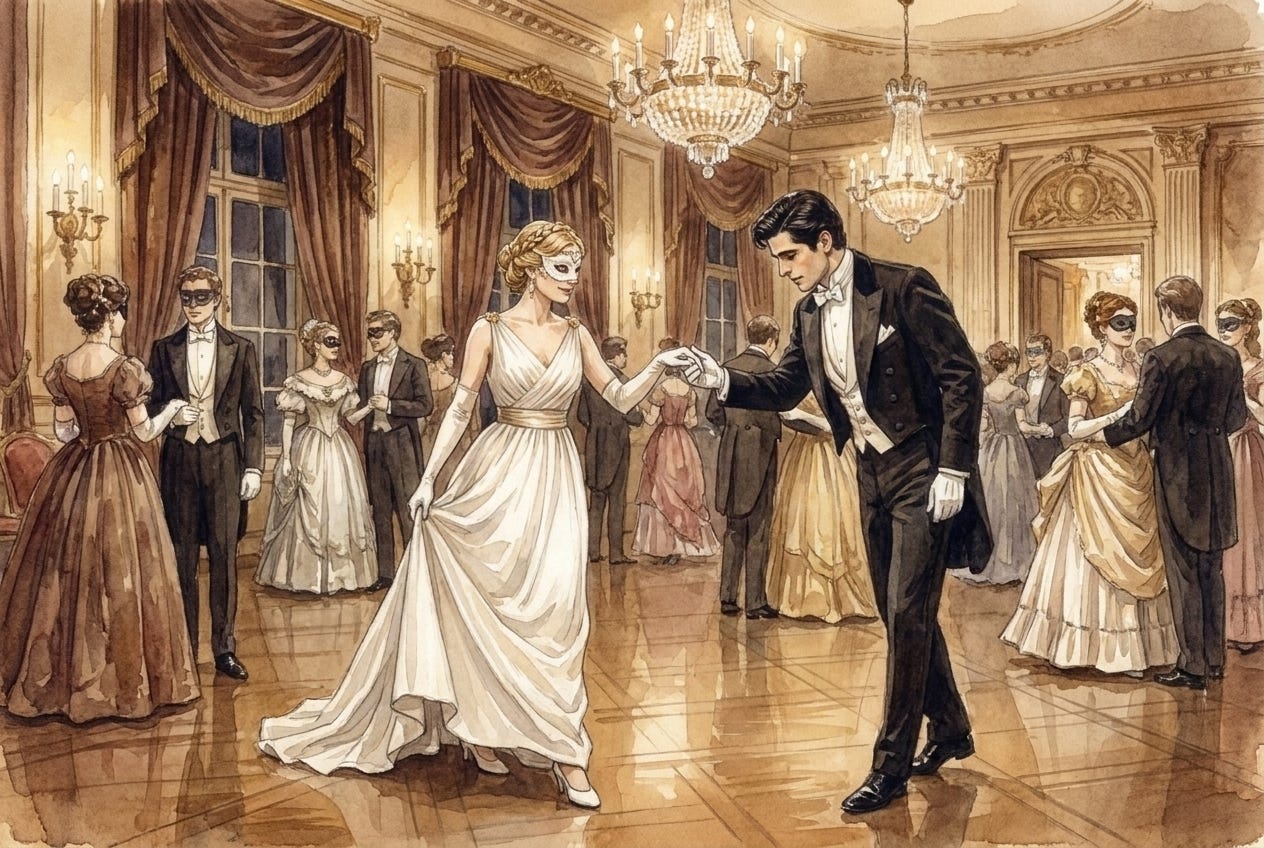
As he took me in his arms and we began to move, I quickly decided he was not being arrogant. If anything, the word fine was a modest one.
His lead was clear and confident without being overbearing, the way so many boys were, always pushing too hard, trying to demonstrate their mastery of the steps rather than guiding their partner through them. I felt safe in his arms, which was an odd thing to notice but impossible to ignore. My hand rested in his, his other hand settled at my waist with exactly the pressure required and no more. We moved together as though we’d danced before.
“You said you paint,” he said as he led me through a turn. “What subjects do you prefer?”
“I started with watercolors. Nature scenes, mostly. Gardens and landscapes.” We moved past another couple, their costumes a blur of red and gold. “But I’ve been working in oils recently. Portraits and city scenes.”
“Oils require a dedicated space, don’t they? A proper studio.”
“They do. Papa is very accommodating. He gave me my own painting studio on the third floor.”
“I’m glad to hear it.” He smiled behind his mask. “I’ve just acquired my first substantial piece. A Liebermann — one of his Dutch works. Peasants working in the fields. My mother thinks it’s depressing, but I find it honest.”
I looked at him with renewed interest. Liebermann was controversial. His work captured labor and poverty with an unflinching eye that made Berlin’s polite society uncomfortable. The fact that James had chosen it, not a respectable landscape or a flattering portrait, said much about him.
“I would very much like to see your paintings,” he continued. “Perhaps I might acquire one for my collection.”
Heat flooded my face. “You don’t need to purchase my attention.”
He missed a step, the first imperfection in his dancing, and his hand tightened briefly about my waist. “Nein. I— That wasn’t my intention at all. I apologize. That came out entirely wrong.”
“I know what you meant.” I softened my tone, aware I’d flustered him. “But perhaps you should see my work before making such an offer. For all you know, my paintings are hideous.”
“I cannot imagine that being so.” His voice had recovered its steadiness. “But you are correct. I’m just very excited about building a collection and anxious to add more pieces, especially from new artists.”
We finished the dance and moved to the edge of the floor. A young man in a harlequin costume stood close, obviously wanting a dance, shifting his weight from foot to foot in a way that announced his intention.
James noticed. “I believe you’re going to be very popular tonight.” He paused, his confidence briefly wavering. “I wonder if you would permit me to dance with you again later. I would very much like to continue this conversation.”
“I would be most agreeable to that.”
I handed him my card. He wrote his name again, below the first entry, and returned it with a small bow.
I smiled, imagining the scandal in the morning as my stepmother reviewed my card and saw his name twice. I knew nothing could come of this, but the displeasure it would bring her pleased me immensely.
“Until later then.”
I curtsied as he left, then stood watching as he disappeared into the crowd, adjusting my assessment of him. Not entirely without charm or intelligence. In fact, I was already looking forward to our next dance.
The young man in the harlequin costume approached, clearing his throat.
“Fräulein? Might I have this dance?”
I glanced at my card. Two entries, both James. I looked up at the young man, picturing the hopeful face that surely lay behind that painted harlequin grin.
“Of course.”

More young men approached, introduced themselves, and requested dances. I added their names to my card — Hoffman, Richter, Klein, Werner, Brauer. All of them polite, some more interesting than others. Hoffman talked about horses for the entire dance. Richter asked more questions about Papa than about me. Klein was handsome and knew it, which made him slightly less attractive. Werner was pleasant and entirely forgettable. Brauer stepped on my foot twice, which was the most interesting thing about him.
By the time the orchestra paused for an intermission, my dance card was nearly full.
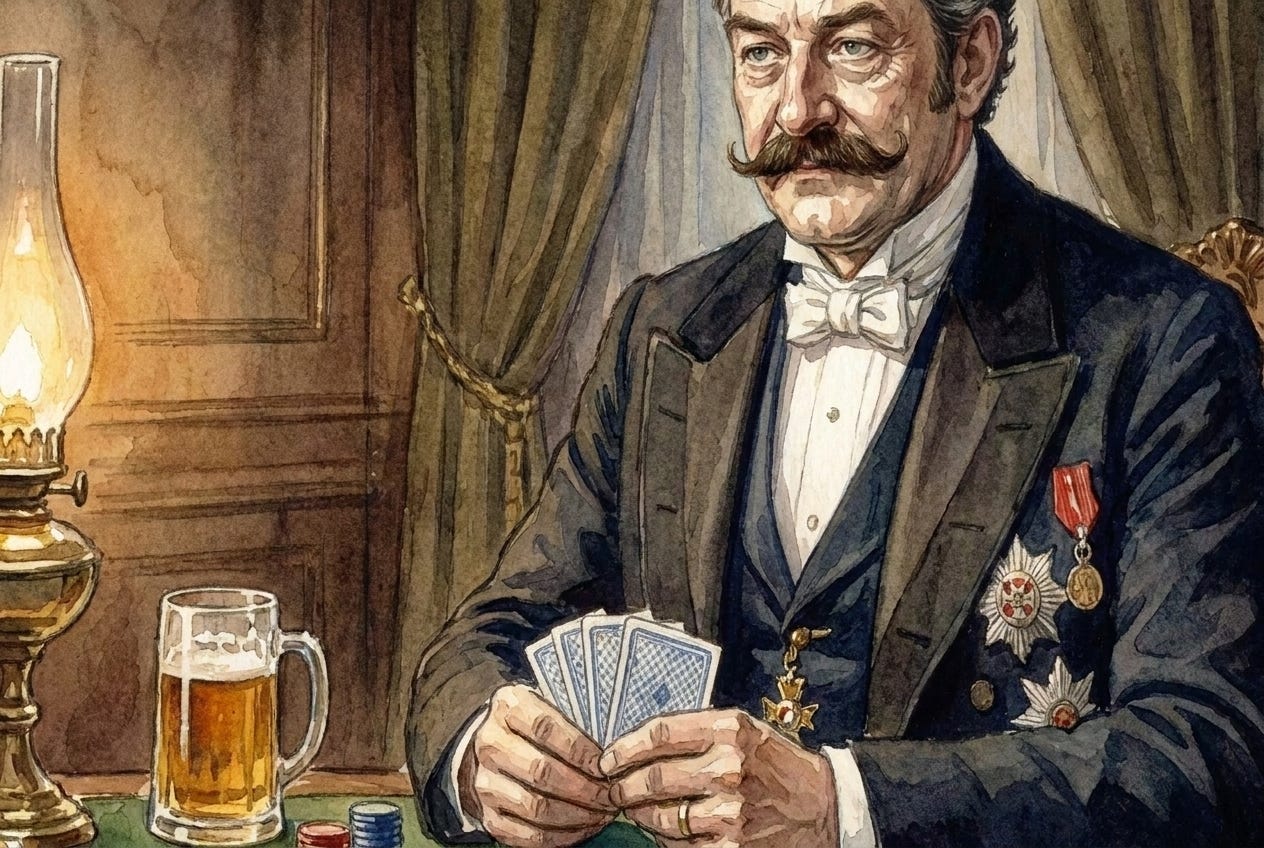
I found Papa in the card room, seated at a Skat table with General von Reinhausen and Herr von Bleichröder, who was taking a brief respite from his hosting duties. Papa looked pleased with himself, which was explained by the considerable stack of Geld sitting before him and the rather serious expressions on the faces of his opponents.
He glanced at my card, eyebrows rising. “You’ve been busy.”
“I’ve been about my business.”
He smiled. “Your stepmother will be delighted.”
“Ja,” I said. “I imagine she will be.”
He glanced at my card again, counting the remaining empty spaces. “Do you still want to leave after the unmasking?”
“I’ve had about enough dancing and socializing for one evening.” I kept my voice light. “But I plan to mostly fill the card as I promised.”
“Good.” He looked back at his hand, considering his cards. “I should be able to relieve these men of their remaining money by then.”
He took my hand in his and squeezed. “Continue about your evening, Liebling.”
Otto was exactly where I expected him to be, at the dessert table in the refreshment room, attempting to enjoy a piece of cake.
“Are you back for more worms?”
He looked up, beak slightly askew. “Ja.” He pecked at the cake with his fork. “Remind me to never dress like a bird again.”
“I’ll try to remember,” I said, accepting a glass of champagne from a passing waiter. The Erdbeerbowle had ceased to be adequate.
“You’ve been dancing a lot,” Otto said.
“I have.”
“And enjoying it, from what I observed.”
“It’s been a more enjoyable evening than I anticipated.” I took a sip of the champagne. “But I’m growing tired of it now.”
“Well then.” Otto set down his plate, brushing crumbs from his gloves. “I must introduce you to a new friend of mine. She moved here from the Rhine last month. You’ll find her delightful.”
“I’m sorry, but I have no patience left for meeting new people.”
He grabbed my hand. “You’ll like her. She’s as passionate and strong-minded as you are.”
“Otto, I don’t—”
But he was already pulling me through the door, back toward the ballroom. He never took no for an answer. He never had.
I doubted anyone at this ball could still interest me. But I followed him anyway, because arguing with Otto required more energy than I possessed.
If you liked this chapter, please click the heart icon below, leave a comment, and/or share. Any and all of these help Substack know to promote my work.
If you would like to read the historical notes for this chapter, you can click here.


